
So just to remind you, here's how my new SL persona, "Zad Cornell," looked when first born and pushed into the Grid; this is essentially how nearly everyone looks when they first come to exist, in fact, which is why it's important to change this look as quickly as possible if you want to have an actual fun experience there, instead of being one of the X amount of people (and there's a lot of them) who try SL for one day, then quit in disgust because "my avatar looked like shit and there wasn't anything to do." Like I said last time, that's the big huge difference between SL and any other Massively Multiplayer Online environment (or MMO), like World of Warcraft or EVE or what have you; there's no actual "game" to play at Second Life, so it's up to the members to come up with ways to amuse each other, aided greatly by a much more robust system than any other MMO for users to create stuff, from avatar components to ownable goods like vehicles and houses, to the computer scripts that will animate it all in specific ways. And so that's why the Grid admittedly looks a lot crappier than other MMOs a lot of the time, because the entire thing except for the land is collectively created from scratch by three million users, and with changes appearing in real time, unlike something like World of Warcraft where a whole team of professional designers can work a year in advance on much more sophisticated backgrounds and avatars that will never change once the game goes live.


So first -- off to get some hair! Or actually, hair and skin are the two most important things to get, usually at the same time; but I find it easier to pick a hairstyle I like based on just its look alone, while to pick the right skin I usually need to see it actually paired with the hair I'm going to have. And to do this, one simply visits some of the "bedroom business" owners like the kind I'm hoping to be soon with prefab housing; this after all is one of the most remarkable things about Second Life, and why it got so much national attention in the mid-2000s when it first became big, is that there's literally millions of real, spendable American dollars exchanging hands between players there every year, from unemployed graphic designers and bored housewives and weekend hobbyists who are essentially running full small businesses there, most of the time concentrating on just one thing like fashion, home accessories, erotic aids, etc. So here I am at one of them, a store called Dura, just full of cool little emo hairstyles like what I'm looking for; and thankfully, a common practice at most SL stores is to offer "demo" versions of their merchandise, which you can wear like normal but which will often have a big "DEMO" warning somewhere on it (in this case, the back of the scalp), so that you can try it out and see how it's going to look on your avatar before purchasing. And so here's a crazy '80s-film montage above of me with all kinds of different possible hairstyles, some of which I ended up liking more than others.


Next -- some eyes! Why yes, this is yet another thing that can be created and then bought and sold within Second Life, which is really just one of the most brilliant things about that place that so many people overlook; that with something like 100 different changeable controls just for the avatars themselves (from big things like height to almost unnoticeable things like the amount your cheekbones protrude), and with every single inch of that avatar able to be swapped out for user-created content, it guarantees a world where you can literally have three million different avatars that all look slightly different from each other, something that no other MMO can come even close to. As you can imagine, with them being so small, eyes are a dime a dozen in SL -- and I mean literally, you can pick up a pack of a dozen different eye colors for one American dime -- so I just basically bought the very first ones I came across that I liked, because there are literally hundreds of thousands of them for sale in the Grid. Hey, don't laugh -- there are lots of people there paying their real-world rent each month from Second Life digital sales, one damn dime at a time.

And next, finally, some decent skin, which is one of the most important things you can do in Second Life; because not only is it a relatively hefty financial commitment, five to six American dollars for a good photorealistic one, thus marking you to other residents as someone serious about wanting to be a good, immersive player, but your avatar is without a doubt the one thing in the Grid you will spend the most time staring at, so it's crucial to get one that you like. And again, the process is the same with the hair -- you simply go around to some stores, download the demos to your inventory (a sort of bottomless invisible suitcase that you carry with you everywhere you go), then mix and match and try them out with the sample hairstyles you now have as well. For those who are confused, what you're actually looking at is nothing more than a Photoshop document that anyone can do, based on a specific template that Linden Lab (owners of Second Life) gives out for free; then their computer coding magic basically takes that Photoshop document and wraps it around a 3D avatar, kind of like when you show a film of a person's face on a white 3D face sculpture. And their coding remembers in that template where all these highly specific marks of a human body are -- here's exactly where the nostrils end, there exactly is where the left eyelid starts -- which is why just one of these Photoshop images will work on all avatars, no matter how you've modified that avatar to be short or tall or fat or thin or whatever.
So that's why a good skin can command a high price like five or six American bucks; because what you're looking at there above is literally some graphic designer drawing this skin in Photoshop with a digital brush, and if you click through to the big version (and seriously, do so), you'll see that with good skins like these, the level of detail that goes into every single millimeter is just astounding, precisely so that you can blow up the image like this and still get such a dizzingly realistic effect. And so what a typical designer will do to maximize the revenue from such a huge amount of work will then offer such a skin in dark, tan and pale versions, and with many times up to six or seven different types of mascara and lipstick options; and then they might sell any one particular copy of these 18 versions for two bucks, an entire line of one shade for five bucks, or all 18 versions bundled together for ten bucks. And since these are as easy to swap out as simply clicking a mouse button, that lets you own a whole series of slightly different skins for different occasions, or even to change them to alien skin, animal skin, or pretty much anything else you can think of.
Oh, and a final thought before moving on -- note again how the only difference between these free demos and the versions you pay for is merely that there's a big "DEMO" tattoo across the faces, and how the only reason that people even bother buying the non-demo versions in the first place is because of the social stigma attached to having "I'M A CHEAP SON OF A BITCH" tattooed across one's forehead. As I've said many times, it's the sociological issues that come with Second Life that I find more fascinating than anything else, and this is a major one, of how so much that makes that universe reasonably ordered and not just some endlessly chaotic teenage anarchy playground is literally the social stigma that comes from not being a "good citizen" while there, which of course can be manifested in literally dozens of ways, from paying for your things to not trolling in chat environments (known as "griefing" within the Grid, and an endless subject of conversation to all avatars), to maintaining "100 percent avatar reality" while at sex clubs (versus constantly bugging other people about who they might be in the real world), etc etc etc.


So when all is said and done, here's the skin, hair and body type combination that I ended up deciding to go with, which cost me a total of seven dollars altogether, making my total commitment now to Second Life $17 since joining again on Friday. Yes, I know, jarring to see a naked avatar, isn't it? Because let's be clear, that this is one of the biggest reasons (if not the biggest reason of all) that a lot of people join Second Life -- because man, if you think that "cybersexing" with a complete stranger via audio and chat online is intense and erotic, just imagine having two photorealistic avatars added that have been scripted to literally fuck each other while you're dirty-talking, within a virtual sex club full of other naked avatars all fucking in front of each other, but with very real human beings guiding their actions and typing their text, making up stories that directly correspond to the action you're all seeing on the screen. And now imagine a million-dollar-a-year cottage industry devoted entirely and exclusively to making these interactions as realistic as possible, and to constantly improving these associated items (animated genitals, fetish gear, scripted sex furniture) so to retain a competitive edge. And that's why there's all kinds of social etiquette rules attached to sexuality in SL, because a lot of people take that shit very seriously in the Grid; and while it's cartoonish in nature, as you can see above it's just exactly realistic enough to make some people very uncomfortable with the mere subject.


And now that I have my finished hair and skin, a quick trip to the first clothing store I can find, so I can buy the first non-embarrassing outfit I can find, simply so I'll have something to wear while out shopping for clothes I like better. Okay -- we're finally approaching a look I'm starting to be happy with!


So next -- some shopping! In fact, I used to talk about this all the time back in 2006, when I was first in Second Life; that for a straight middle-aged male, I find a surprisingly high amount of enjoyment in the Grid simply from the act of shopping for little girly outfits, which frankly is one of the top two or three things in the entirety of Second Life that people do for "fun," which is why Second Life has an insanely higher female customer base than any other MMO in existence. As you can see, most of the micro-entrepreneurs who take their businesses seriously have basically these big warehouse-type stores for people to visit, which gets into an important technical detail of Second Life that I haven't described yet; because just as one physical server at Linden Lab covers one square of the big map, or 32,000 square meters of virtual land, how they keep control over how loaded-down those servers get is by allowing only around 7,500 "prims" per region to be built (or more specifically 117 prims per 512 square meters, the smallest amount of land that one can buy and sell in the Grid). A prim, then, or "primitive shape," is the basic building block with Second Life from which everything else is based; so a wall might be one prim, and a window another prim, and the section of wall that goes between two windows yet another prim, while a fancy piece of furniture might run 20 or 30 prims just on its own.
So landowners are always looking for ways to save on prim count, which is why stores will often consist of just the most basic, minimal shapes one can get away with, so that more prims can be devoted to the actual merchandise, which is yet another way I find the Grid so fascinating, the manner in which these kinds of tech limits end up sorta self-regulating the way the entire universe looks and behaves. And the way you shop, then, is how you're seeing above -- there's basically a touchable prim for each and every item that store sells, and when you touch it a script activates that will let you pay it money, at which point it will automatically deliver a piece of merchandise straight to your inventory. And that's...well, that's frankly a backwards way of doing things, in a real world where brick-and-mortar stores are more and more losing out to giant online database businesses like Amazon, but backwards is sometimes the way that people exactly want things in Second Life, so to feel more like they're at an actual place with actual stores, that you actually have to walk through in order to actually stumble across accidental deals and the like. Which is why you have all these giant cavernous warehouses in order to show off several hundred items for sale, which you could've done a lot easier and with a lot less fuss on a single page at a single website. Like I said, the issue of "immersion" is a paramount one to all serious players of Second Life, manifested all the way from sex rules to social etiquette to this reliance on outdated brick-and-mortar paradigms for commerce there.


And so after a long weekend of hunting, shopping and modding, here finally is a look and feel for Zad that I think I will probably be sticking with; for while all of these things can be changed with a click of a button, including turning into an eight-foot-tall man in a few seconds right in front of other people's eyes, this is part of the "dedication to immersion" I was telling you about, that serious players tend to stick with the same body type, skin and hair from one day to the next, literally so that their friends can recognize them by sight whenever they walk into their favorite hangout. Oh, and if I haven't made it clear yet, after sex and shopping this is undoubtedly one of the other main three reasons that people enjoy Second Life, is to gather with their friends and have essentially group chat sessions via text and voice, only in environments that are designed to look like clubs and full of animation scripts that make clubgoers dance, often featuring an actual live DJ streaming in music from their home computer and taking requests, or sometimes even live musicians who are actually playing their instruments out there somewhere in the real world, and with an audience gathered from scattered locations globally who are all listening and responding in real time. And not by coincidence, this is what fuels a lot of the shopping going on there, so that people will always have new outrageous outfits to show off to their friends; and this in turn fuels a lot of the micro-entrepreneuralism that's going on there, a self-feeding cycle which is what keeps so many people coming back day after day after day, despite a total lack of "goals" and "adventures" and "leveling up" and the other elements of almost every other MMO in existence.


Or, well, I actually put a second outfit together as well, with a second hairstyle I find gorgeous but I don't think I'd want to wear around all the time; although this outfit doesn't work as well, because it's what's known as a "mesh prim" (i.e. one that can be actually shaped into complex patterns via CAD/CAM software), which means that it actually hangs off an avatar itself instead of being a Photoshop texture that is merely wrapped around the surface of an avatar. And so that means that that designer has to design that prim to be one objective size instead of instantly adjustable; and so when you have an extra-small avatar like mine (who I designed deliberately to be 5'2", when most avatars are more like seven feet tall to help balance out the oversized nature of everything else), it means that a mesh outfit like this dress above is simply not going to fit exactly right, as you can see in the see-though sections by the neck and the weird-looking boobs. But in any case, it's good enough to at least go kicking around; and since my goal this time in Second Life is to get up and going as a revenue-generator as quickly as I can, versus last time when I was an arts-and-entertainment blogger who was constantly attending fashion shows and club openings, these are probably the only two outfits I'll have for quite some time, just enough to get around and do my business without embarrassing myself in front of other serious players. And so everything you're looking at in these photos -- the skins, the hairdos, the clothing, the tattoos -- all came out to around twelve dollars, which means that my "not a moron money" goal (or that is, the amount of money I need to make before I can prove that I wasn't a moron for joining Second Life again) is now officially at $22, which then automatically increases to $32 a month from now when my next bill for being a premium member comes due.

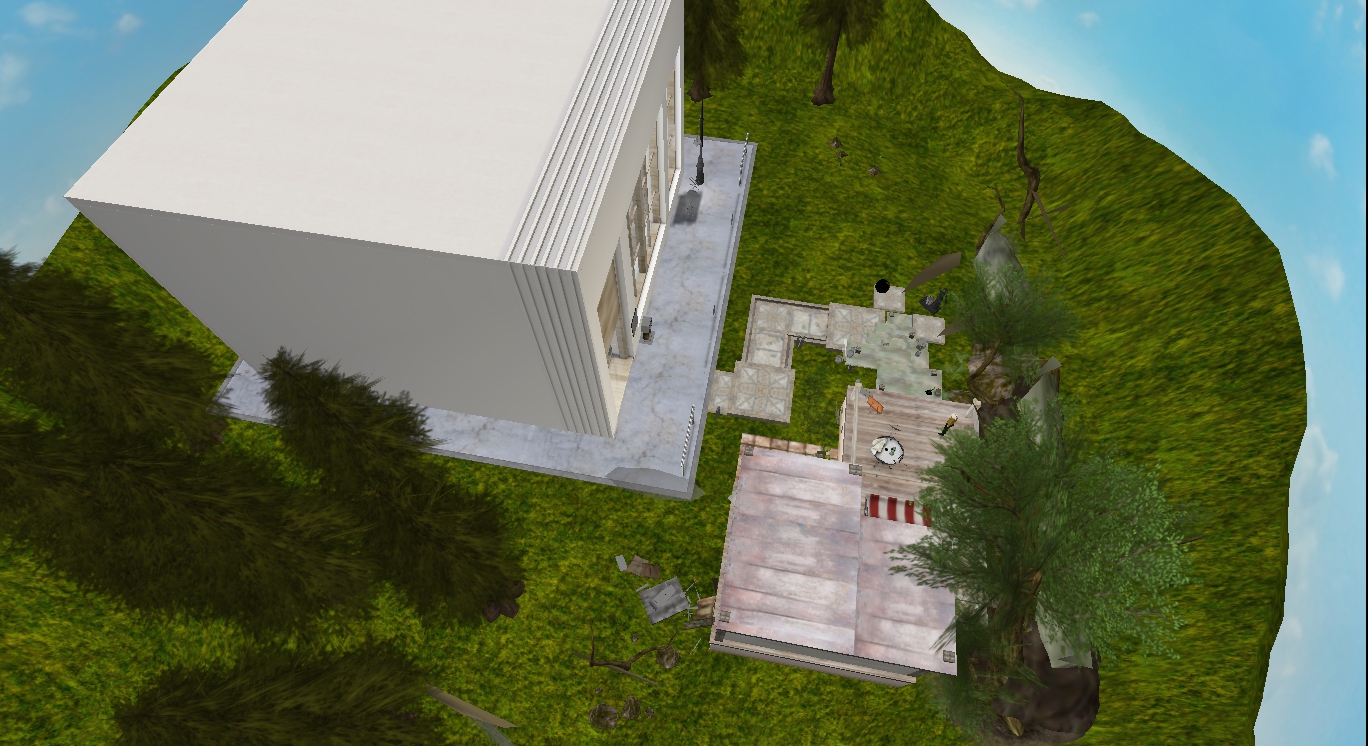
So that's it for now from my starter home in IKEAville here in the Grid, and I hope that you've found these two extra-long entries this weekend to be interesting. Coming next week -- shopping for a large parcel of land, so that I'll have the space to start construction work on my first prefab home, which I'll technically be able to sell at Second Life's online marketplace before having to construct my own retail space in-universe. As always, many more details and screenshots coming about all that very soon. End of line, users!


